
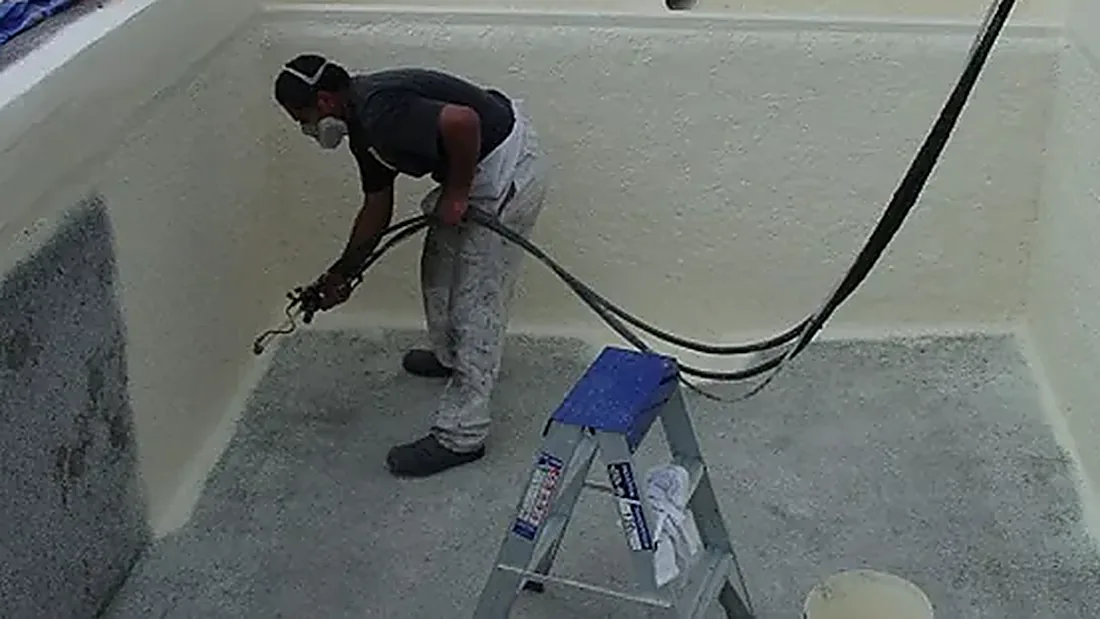
Water Tank Waterproofing
How a concrete water tank is waterproofed, the exposures that attack it, and which Sika® systems apply — including what Sika lists for potable water. Stocked in Riyadh and Jeddah.
How do you waterproof a water tank?
Not with a single coating. Sika treats a water-retaining structure as a four-part system: keeping groundwater out of a below-ground tank, making the concrete itself watertight, protecting the internal surface that touches the stored water, and repairing localised damage compatibly. Which parts you need depends on whether the tank sits above or below ground, and on its condition.
Where the tank holds drinking water, Sika sets four requirements. The waterproofing must be:
- Watertight over long periods
- Easily maintainable
- Food safe
- Harmless to health
Those four are the reason product selection here is not interchangeable with roof or basement waterproofing, and why the approval position has to be confirmed rather than assumed. Sika's own guidance is that the most suitable system depends on the nature of the reservoir structure and the water quality — so the tank details matter more than the product name.
Source for this page: Sika GCC — Solutions for Potable Water Treatment Plants & Reservoirs.
System solution overview
The four parts of a tank system
Sika's structure for water-retaining works. A given tank may need one part or all four.
- 1
External waterproofing
For below-ground storage, the structure is protected from groundwater entering it. Sika lists fully-bonded polymeric sheet membranes (SikaProof® A+, SikaProof®-808) and bituminous membranes (SikaShield® W, Sika® Igolflex®). Applied before or during construction, so it is a design decision rather than a later repair.
- 2
Concrete solutions
The Sika Watertight Concrete System: concrete modified with admixtures to produce waterproof concrete, plus selected waterstops at construction and movement joints. Sika lists Sika® WT-200 P as the admixture and Sika Waterbar®, SikaSwell® A and Sikadur-Combiflex® SG for joints. Watertight structures can be designed to keep water in, out, or both.
- 3
Internal waterproofing and protection
The surface in contact with the stored water. Four routes: waterproofing mortars (SikaTop®-107 Seal, Sikalastic®-1K, Sika®-110 HD), multi-layer epoxy resins (Sikagard®-62, SikaCor®-146 DW), hot-spray polyurea membranes (Sikalastic®-840 ES, Sikalastic®-836 DW) and TPO sheet membranes (Sikaplan® WT 4220, WT 4300).
- 4
Concrete repair
Where water is lost through localised damage, the repair must be compatible with the existing waterproofing — watertight concrete or mortar-lined. Sika lists Sika MonoTop®-1010 and Sika MonoTop®-4012 for spalling, Sika® Injection-201 CE and Sika® Injection-306 for repair injection, and Sikadur-Combiflex® SG for joints.
Products in bold are ones we hold. For the full system detail see Sika waterproofing systems and Sika waterproofing mortars.
Typical exposures
What actually attacks a water tank
Sika identifies eleven common exposures affecting water storage areas. Which ones apply to your structure is what decides the system — a lining that handles chlorine and disinfectant is not automatically the one that handles hydrostatic pressure from outside.
- Low pH value
- Soft water
- Fungi
- Hydrostatic pressure
- Algae
- Micro-organisms
- Disinfectant
- Stray currents
- Water turbulence
- Chlorine
- Alkalinity of concrete
What Sika weighs when specifying
Durability and water-tightness · exposures, site conditions and ecology · ease of maintenance · food safety and harmlessness to health · compatibility of systems · life cycle costing.
Reservoir types
Above ground covers tanks and towers; below ground covers tanks and caverns. An above-ground tank generally needs the internal system and joint treatment. A below-ground tank adds the external side, because the drinking water has to be protected from groundwater entering the structure.
Drinking water
Potable tanks: what Sika lists
Sika states that its waterproofing products used in potable water reservoirs and tanks comply with the strict regulations of public water authorities, and that the food and beverage industry relies on these systems in process water tanks.
From the systems Sika lists for potable water structures, these are the ones we hold:
- SikaTop®-107 Seal — two-component polymer-modified rigid waterproofing mortar, listed under internal waterproofing and protection. We stock it as SikaTop®-107 Seal AE.
- SikaSwell® A — hydrophilic swelling profile, listed for joint sealing.
- Sikadur-Combiflex® SG — post-applied bonded tape, listed for joint sealing and for repair.
- Sika® Injection-201 CE — two-component PU injection resin with drinking water approval, listed for repair injection.
- Sika MonoTop®-4012 — R4 concrete repair mortar, listed for concrete spalling repair.
Sika also lists systems we do not routinely stock but can advise on and source: Sika®-110 HD, Sikagard®-62, SikaCor®-146 DW, Sikalastic®-1K, the Sikalastic®-840 ES and -836 DW hot-spray membranes, and the Sikaplan® WT sheet membranes.
One thing not to assume. Not every tank coating is a potable system. Sikagard®-320 EPS is specified for non-potable structures. Sikagard® PW is not in Sika's potable product list either, although Sika's potable water page does cite it, with Sikafloor®-161, on a desalinated potable water storage tank in Al Khobar — so treat its suitability as project-specific rather than general. Tell us the tank holds drinking water when you enquire and we will confirm the approval position for your exact application before quoting anything.
Full detail, brochures and case studies: Sika GCC potable water treatment plants. For effluent and treatment works see Sika solutions for waste water treatment plants.
Joints and penetrations
Where tanks actually leak
In most tanks the body of the slab is not the leak path. The construction joints, movement joints and penetrations are — which is why Sika treats joint sealing as its own part of the system.
- 1
Construction joints
SikaSwell® A, a hydrophilic swelling profile that Sika lists for joint sealing in water-retaining structures.
- 2
Movement joints and cracks
Sikadur-Combiflex® SG, post-applied bonded tapes. Sika's own reference projects include 900 m of Combiflex SG tape in a potable reservoir in Dupail, France.
- 3
Cracks and voids in the structure
Sika® Injection-201 CE, the PU injection resin Sika lists with drinking water approval, for repair injection.
More on joints: Sika joint sealing.
Products
Water tank products we stock
Add what you need to a quote request, or download the data sheet. Where a note says Sika lists a product for potable water, that is from Sika's potable water solutions page.
SikaTop 107 Seal AE
SikaSwell A
Sikadur Combiflex SG 10 P
Sika Injection 201 CE
Sika MonoTop 4012
Sikalastic 152 SA
SikaTop 550 Seal
Sika MonoTop 108 Water Plug SA
SikaTop Armatec 110 EpoCem
Sikagard PW
Sikagard 320 EPS
Sikalite AE
Always confirm the current Sika technical data sheet and the approval position for your specific application before use. Where the right answer is not obvious, ask us and we will check it with Sika rather than guess.
Common questions
Water tank waterproofing FAQ
What is the best way to waterproof a concrete water tank?
Sika treats a water-retaining structure as a four-part system rather than a single coating: external waterproofing to keep groundwater out of a below-ground tank, watertight concrete with waterstops at the joints, internal waterproofing and protection on the surface in contact with the stored water, and concrete repair where there is localised damage. Which parts you need depends on whether the tank is above or below ground and on its condition. Sika's own guidance is that the selection of the best system depends on many factors including local water conditions, the nature of the reservoir structure and the water quality.
Which products does Sika list for potable water tanks?
On its potable water treatment plants page, Sika lists waterproofing mortars (SikaTop-107 Seal, Sikalastic-1K, Sika-110 HD), multi-layer epoxy resins (Sikagard-62, SikaCor-146 DW), hot-spray polyurea membranes (Sikalastic-840 ES, Sikalastic-836 DW) and TPO sheet membranes (Sikaplan WT 4220, WT 4300) for internal waterproofing and protection. For joints it lists Sika Waterbar, SikaSwell A and Sikadur-Combiflex SG; for repair, Sika MonoTop-1010, Sika MonoTop-4012, Sika Injection-201 CE and Sika Injection-306. Of these we stock SikaTop-107 Seal AE, SikaSwell A, Sikadur Combiflex SG, Sika MonoTop-4012 and Sika Injection-201 CE. Tell us the tank holds drinking water when you enquire and we will confirm the approval position for your specific application before quoting.
Can you use a membrane for water tanks?
Yes. Sika lists two membrane routes for potable water structures. Hot-spray membranes are two-part, elastic, 100% solids polyurea systems (Sikalastic-840 ES and Sikalastic-836 DW). Sheet membranes are flexible TPO systems (Sikaplan WT 4220 and WT 4300), thermally welded. For below-ground tanks Sika also lists external fully-bonded polymeric sheet membranes, SikaProof A+ and SikaProof-808, applied to keep groundwater out of the structure. Alongside those, waterproofing mortars such as SikaTop-107 Seal are used as a rigid internal system. Which route suits depends on the structure and the water quality, so send us the details and we will come back with the system.
How do you stop a water tank that is already leaking?
Sika's guidance is that when there is loss of water in reservoirs or tanks due to localised damage in the rigid waterproofing system, the repair must be compatible with the existing waterproofing system, whether that is watertight concrete or a structure lined with waterproofing mortar layers. The repair route depends on the damage: concrete spalling is addressed with repair mortars such as Sika MonoTop-4012, cracks and voids by repair injection with resins such as Sika Injection-201 CE, and joints with Sikadur-Combiflex SG tapes. Send us photographs and the tank details and we will identify the compatible system.
What attacks a water tank and causes it to deteriorate?
Sika identifies eleven common exposures affecting water storage areas: low pH value, soft water, fungi, hydrostatic pressure, algae, micro-organisms, disinfectant, stray currents, water turbulence, chlorine, and the alkalinity of the concrete itself. Understanding which of these applies to your structure is what determines the right system, because a coating that handles chlorine and disinfectant is not necessarily the one that handles hydrostatic pressure from outside. Sika's design considerations are durability and water-tightness, exposures and site conditions, maintainability, food safety, compatibility of systems, and life cycle costing.
Do you deliver water tank waterproofing materials across Saudi Arabia?
Yes. We hold stock in Riyadh and Jeddah and deliver to project sites across the Kingdom, including Makkah, Madinah, Dammam, Khobar, Jubail, Yanbu, Taif, Abha, Tabuk, Qassim, Hail, Najran and Jazan. Tell us the tank size, whether it holds drinking water, and the date you need the material, and we will confirm quantities and the delivery window with your quotation.
Reference
On Sika's own site
Where you need more depth than this page carries, these are the manufacturer's pages behind it.
- Potable water plants & reservoirs
- Solutions for potable water treatment plants — system overview, exposures, brochures and case studies.
- Waterproofing systems
- Sika waterproofing systems — the full structural waterproofing range.
- Waterproofing mortars
- Sika waterproofing mortars — the rigid internal route.
- Joint sealing
- Sika joint sealing — waterstops, swelling profiles and bonded tapes.
- Waste water structures
- Solutions for waste water treatment plants — for effluent rather than potable duty.
We are an authorised Sika distributor and are not affiliated with Sika AG beyond that distribution relationship. These links go to Sika's own website.
Tell us about your tank
Send us the tank size, whether it holds drinking water, whether it is above or below ground, and its current condition. We'll come back with the system, quantities and the data sheets.